Secrets of Cuban Roast Suckling Pig: The Star of Every Party
Cuban roast suckling pig is tradition, family and the flavor of Cuba. History, criollo mojo and how to keep this tradition alive wherever you are.
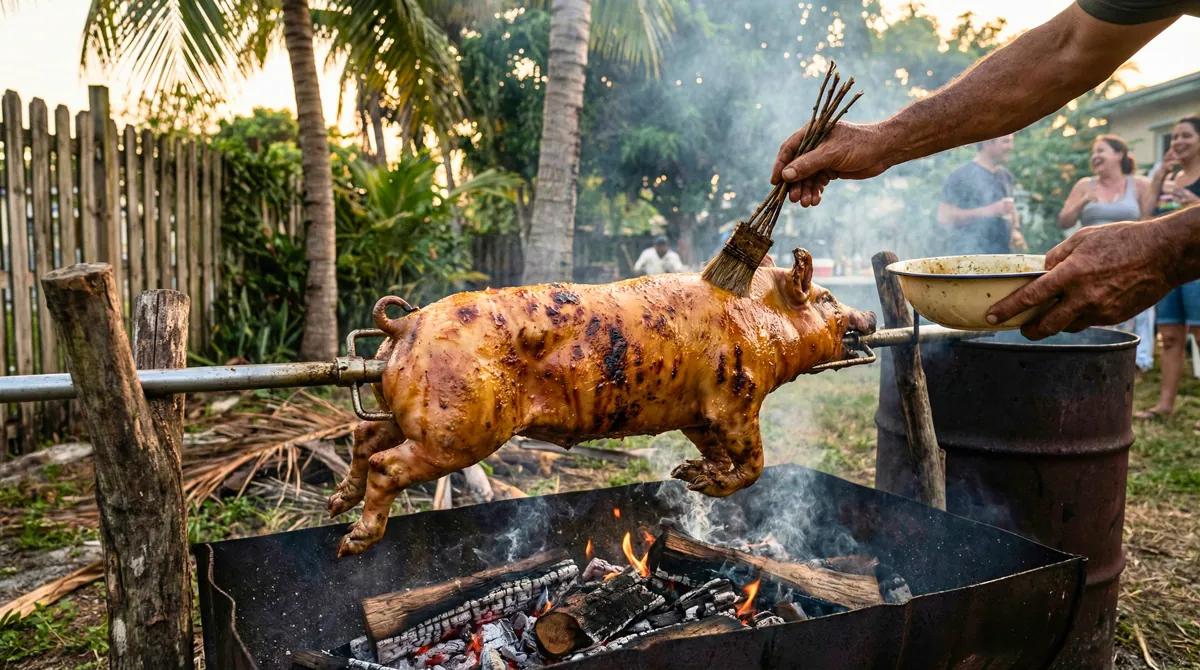
Close your eyes for a moment. Do you feel it? That unmistakable aroma of golden pork, of mojo criollo, of charcoal and bitter orange mingling in the air. It is the smell that announces the holidays have arrived, that the family is together, that even if we are far from Cuba, we carry our land in our hearts... and in the kitchen.
Roast suckling pig is not just a dish. It is grandma's hug, the laughter in the yard, the sound of dominoes as we wait for it to be ready. It is our way of saying "here we are, together, keeping the tradition alive".
A Tradition That Spans Centuries and Seas

The history of the Cuban roast suckling pig began more than 500 years ago, when Christopher Columbus brought the first pigs to America on his second voyage in 1493. But it was the Taínos, the original inhabitants of our island, who taught the Spanish colonists something revolutionary: the art of the barbecue.
The Taínos dug a hole in the ground to concentrate the heat from the wood toward the meat, placed on a grill or skewered on a spit suspended between two stakes. This ancestral technique fused with Spanish traditions of roasting suckling pigs, and thus something unique was born: the Cuban roast suckling pig.
By the late 19th century, publications of the time reflected how the suckling pig had become the undisputed symbol of our December celebrations. And in the 1950s, the Cuban folklorist Samuel Feijóo captured the essence of this tradition in Bohemia magazine, describing the Christmas Eve roast suckling pig as a "Cuban Easter rite, one of the largest and most joyful," and noting that the Cuban "sacrifices himself, strives, in order to celebrate Christmas Eve with dignity."
"That night is the night of the year, poverty does not count. To celebrate it he resorts to all his resources. Not being able to fulfill the tradition is a very hard blow to his morale."
Not even the hardest years could erase this tradition. Although the Christmas festivities were officially suspended in Cuba in 1969 — amid the 10-million-ton sugar harvest — Cubans continued to gather with family, seeking even a little "masita" of pork to celebrate. It was not until December 1997, on the eve of the historic visit of Pope John Paul II to the island (January 1998), that the government declared December 25 a holiday. Initially announced as "exceptional," the holiday remained and Christmas officially returned to Cuba.
From Christmas Eve to New Year's Eve
Why the suckling pig and not another dish? Because cooking a whole pig is an act of generosity, of abundance, of collective celebration. It is not food for just one; it is food to share.
Over the years, the tradition of the roast suckling pig in Cuba has increasingly shifted toward the celebration of New Year's Eve. While in the past Christmas Eve was the center of the festivities, today many Cuban families reserve the suckling pig for December 31, combining the farewell to the old year with this culinary ritual that defines us.
Whether on the 24th or the 31st, the ritual begins days before. Getting the suckling pig, preparing the mojo, cleaning and seasoning the meat... everything is part of the party. And while the pig cooks slowly, the family gathers: the men tending the fire, the women preparing the side dishes, the children running around, and everyone waiting for that magical moment when the skin turns golden and crispy.
Did you know there are regional differences? In the east of Cuba, the tradition is to roast the suckling pig on a spit (skewered on a rod). In the west they prefer the horizontal rod, and in the center of the island the grill is more common. Each family has its method, its secret, its way of doing it "as grandma used to do."
A Tradition that Endures: The Suckling Pig in Difficult Times

It must be said honestly: in today’s Cuba, keeping the tradition of the roast suckling pig alive has become a true challenge. The deep economic crisis the island is going through has hit pork production hard. According to official figures, Cuba went from producing about 200,000 tons of pork in 2017-2018 to barely 9,000 tons in 2024, a drop of more than 95%.
📊 The reality in numbers:
- Price per pound of pork in 2020: 40-50 Cuban pesos
- Price at the end of 2024: more than 1,000 pesos (up to 1,400 on the informal market)
- Average monthly salary: 4,000-5,000 pesos
And yet, Cubans make do. They save for months, band together with neighbors to share a pig, look for smaller alternatives. Because giving up the year-end lechón is giving up something deeper than food: it is letting go of a piece of identity, of memory, of family.
That is why, for Cubans of us who live abroad, preparing a roast suckling pig has a special meaning. It is our way of honoring those on the island who fight to keep this tradition alive, and of ensuring that our children and grandchildren know the taste of Cuba.
The Creole Mojo: The Soul of the Roast Suckling Pig

If the lechón is the body, the mojo criollo is the soul. This magical marinade is what transforms a simple roasted pork into the most desired dish at Cuban celebrations.
The ingredients are simple but powerful:
Sour Orange
The citrus that defines Cuban flavor
Garlic
Generous, crushed, essential
Oregano
The Mediterranean herbal touch
Cumin
Warmth and depth
Salt and Pepper
The basics that balance
Lard
To bring all the flavors together
The secret is in the time. A good lechón needs to marinate for at least 12 to 24 hours, so that the mojo penetrates deeply into the meat. Some inject the mojo directly into the thickest parts; others prefer the traditional method of piercing the meat and letting it naturally absorb the marinade.
Cooking Methods: From the Spit to the Caja China

On a Spit: The Ancestral Tradition
The oldest method and perhaps the most romantic. The suckling pig is skewered with a sturdy wooden rod (traditionally guava, for its aroma) and placed over the embers. It requires patience: you must turn it constantly for 5 to 7 hours, making sure the fire is even.
La Caja China: Cuban Innovation in Miami
📦 Fun fact: In 1955, a young Cuban named Roberto Guerra saw a similar cooking box in Havana’s Chinatown. Thirty years later, on December 23, 1985, already exiled in Miami, he built his own version with his son in a Hialeah warehouse. That’s how La Caja China was born, which today is used worldwide to prepare the perfect lechón.
The caja china revolutionized the way of roasting: the pig is cooked with heat that descends from coals placed on an upper tray, achieving even cooking in about 4 hours. The meat stays juicy inside and the skin becomes incredibly crispy.
In the Oven: The Modern Adaptation
For those without a yard or a caja china, the oven offers a practical alternative. An 8–10 pound pork shoulder, well marinated, can be cooked at a low temperature (325°F). Estimate between 20 and 30 minutes per pound of meat, depending on the exact temperature and cut. Increase the heat at the end to brown the skin.
The Side Dishes that Complete the Celebration

A roasted suckling pig never comes alone. The Cuban year-end table is a festival of flavors that complement each other perfectly:
Congrí Oriental or Moros y Cristianos
The rice with beans that defines whether you're from the East or the West. Without this, there's no party.
Lettuce and Tomato Salad
Simple but necessary. The fresh touch that balances so much abundance.
Take Cuba Wherever You Are

Whether in Miami, Madrid, Barcelona or any corner of the world, every time a Cuban roasts a lechón at the end-of-year parties, they are doing much more than cooking. They are saying: "I do not forget where I come from. I do not forget who I am."
The crunchy skin, the juicy meat, the aroma of the mojo... are our way of keeping the connection with our homeland alive, with our ancestors, with those memories from when we were children eagerly waiting for grandfather to announce "it's ready!"
Because the Cuban roasted lechón is not measured in pounds or hours of cooking. It is measured in shared hugs, in stories told around the fire, in tears of joy when we finally all sit together at the table.
And today, knowing how difficult it is for our families in Cuba to keep this tradition, every lechón we roast outside the island is also an act of love and solidarity. It is telling them: "We are still here, keeping the taste of home for when we meet again."
Ready to Prepare Your Lechón This Year?
In our official app you'll find the complete roasted lechón recipe with all the secrets of mojo criollo, exact cooking times, and step-by-step instructions so it turns out perfect.
You will also discover:
✅ Traditional mojo criollo recipe
✅ Complete guide to yuca with mojo
✅ Authentic eastern congrí
✅ Full Christmas Eve and New Year's Eve menu
Access the Official RecetaCubana App 🇨🇺
Frequently Asked Questions about Cuban Roasted Lechón
What is the ideal weight for a lechón to roast?
How long should the lechón be marinated?
Can I substitute sour orange in the mojo?
How long does it take to cook a lechón?
What is the secret to getting the skin crispy?
Did you like this article? Share it with your family and let's keep the Cuban tradition alive together.
#RoastPork #CubanChristmasEve #CubanNewYearsEve #CubanFood #CubanRecipe #CubansAroundTheWorld